Layon article from 1901

Don Rice

Don Rice
How about a little vinous reading warmup for the new year:

A friend in France asked for a pdf of this uncommon 1901 essay about the Layon. Here's a link to the full text for anyone else who may be interested.

http://www.loireviticultureindex.net/iWeb/Bib/Bouchard_1901_RdV.pdf

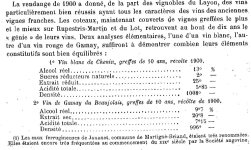
Its author was the point man in Anjou during the phylloxera crisis. The article was published at a time when the replanted vines had grown a bit, enough to be in production again. He reminds the reader of the Layon's long history of winemaking and documents the introduction of some of the region's grape varieties. He's also quite pleased with the chemistry of the 1900 vintage, the wines "having all the character of the old free (ungrafted) vines." (p13)

What's interesting is that mechanization is just beginning to make inroads within the chai. In the 1800s we saw more vines being trained on wire out in the vinyards. Here we see mechanical crushers and presses becoming more common. It wouldn't be long before motorized pumps, tractors and municipal niceties like electricity and indoor plumbing enter the picture in a big way. But in this piece, we're still looking at the Layon from more of a 19th century perspective. Big changes were a comin'.

If you're in to time travel, this may be a nice diversion. Below are a few screen shots.

title.jpg
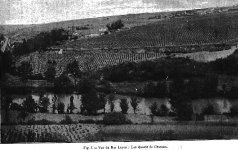
chaume.jpg
1900.jpg
bonnezeaux.jpg
 

Attachments

  • title.jpg
    title.jpg
    88.4 KB · Views: 0
  • chaume.jpg
    chaume.jpg
    174.2 KB · Views: 0
  • 1900.jpg
    1900.jpg
    164.4 KB · Views: 0
Fascinating. I noted the higher acidity and low alcohol in the Gamay. I wonder how much was planted there then vs. now (or has it all been pulled from the more prestigious AOC?) Also the lack of trees in the photos - is it (like much of New England) more forested now than a century ago?
 
I love this sort of stuff. It not only challenges my French skills (I kept looking for my standby marker words "pommes frites" and "foie gras" to no avail) but forces me to learn stuff I didn't know before, while asking questions that might not have answers (like "the land in the Bonnezeaux picture looks like fields but is it now covered with vines?").

While I'm a long-time appreciator and reader of wine books, for a long time I can't say that I knew diddly about Loire wines over and above the fact that Sancerre is made from Sauvignon Blanc and that Pouilly-Fum is too, but is different from Pouilly-Fuisse by a long shot. I got by as a wine clerk for a lotta years wowing my clientele with the depth of my knowledge by using examples such as this. Such are the advantages of selling wine in the largest chain of combination liquor and ammo stores in Appalachia.

I try not to get too hung up on facts and figures when I'm learning about a new area but just catch a ride with the general flow and let osmosis take over, giving me a warm glow of being "in the know". I think I picked up most of my Loire information when a well-meaning customer recommended that I check out the writing of the late Dean "The Loire Schnauzer" Delahanty. Dean wasn't big on history though, unless it was about him making history with his muckraking exposs about the decline of Joguet in the late 90s and its subsequent improvement after the dawn of the new millennium. His writing wasn't all "glass half-empty" though. His revolutionary writing put Clos Rougeard on the map and made it one of the most sought-after, collectible wines on the face of the planet, at least the ones from France. I mean, this guy had a huge impact on me and I'll admit to being kind of dismayed at the poor choices made the night he was taken from us, but I give more than a little credence to the conspiracy theorists out there who believe that the Syndicat des Vins de Chinon (irked at his seemingly favoritism toward Saumur reds) may have been behind him being discovered by authorities in a hot tub with the teenaged Miss Muscadet and her court in a state of undress that would be well, unbecoming anywhere other than the Playboy mansion's grotto. Of course the sending in the gendarmes in full SWAT attire was overkill, and that's just what it did, it gave the old Schnau (that's what we called him) a heart attack. He. Died. From Shame. (and regret, shock, and the bad Romanian wine he was plying his hot tub companions with. It's hard nowadays to think that this sort of mortification could turn into something having to do with mortuary work, but remember that in those pre-Tiger Woods days people tended to mind their own business. I heard that his widow got a nice settlement from the syndicat to keep the scandal hush-hush, and the royal court was shepherded quickly away to prevent further bad publicity. The wine world still lacks a critic with the suasive abilities and overall influence exploited by Delahanty, at least when it comes to words about the Loire.

But I digress...

Dean "The Loire Schnauzer" Delahanty's newsletters are prized by collectors today; my hope is that Don, you've got these in your collection so generations to come will be able to learn from the ol' Schnau. The tawdriness of his demise will fade from memory, certainly within a couple of generations. Then, people will be able to learn about the "sizzle" of Loire lore. For now, I'm more than happy with the "steak" that Don provides in his Loire excavation efforts. Keep up the good work; we're out here lapping this stuff up.

-Eden (this old Loire stuff is just right for a mini-series on TV5)
 
Anjou Gamay AOC shares a lot of the same turf as CdL. Don't know the productions figures offhand or the trend over time, but that info is certainly out there.

Maybe the trees were planted to protect the new vines? In the QdC pic the vines would be about ten years old, max.

(Good ol' Dean Delahanty. He would know for sure!)
 
Maybe the trees were planted to protect the new vines? In the QdC pic the vines would be about ten years old, max.

The reforestation in New England in a large part occurred as farms were abandoned or reduced in size when cheaper food from more efficient farms or productive soils/climates out West became available. The same thing may well have happened in France, both within and outside the wine sector. I believe the large scale production of Languedoc-Roussillon wine didn't occur until canals and then railroads made the northern markets accessible to them.
 
Back
Top