
You are using an out of date browser. It may not display this or other websites correctly.
You should upgrade or use an alternative browser.
You should upgrade or use an alternative browser.
New Yorker article about smoke taint
- Thread starter Brad Widelock
- Start date
Eden Mylunsch
Eden Mylunsch
Just read it this morning and I found myself "speed reading" through some of the scientific sections. Where's Professor Lipton when I need him to 'splain the deep stuff to me?
Prior to reading the article, I'd always thought of smoke taint as an A/B, Yes/No, Evil/Eviler proposition, but if I squint, I can kinda see that for some people, it can be an "I know bad wine when I taste it" situation. Personally, smoke taint is like TCA for me -- a little bit ruins the entire experience. And having tasted extensively from the Paso Robles 2020 vintage, not only is the ashiness from the first sip noticeable, but it reverberates on into whatever wines I'm tasting after. When involved in tastings that incorporate that region/vintage I'll always save those for last, so as to not contaminate any wine other than those that might already be afflicted.
The reality is that, just as with TCA taint, most consumers aren't going to register the wine as flawed as much as they'll just not like it and never order it again. Sure, brushfires may be part of the terroir in the sense that the wines reflects the conditions they were grown in, but not all of it can be disguised as bourbon-barrel aged Malbec or a generic red blend.
-Eden (isn't it odd that virtually every winery dealing with smoke or too much rain always seems to have just harvested before the fires or the watery deluge?)
Prior to reading the article, I'd always thought of smoke taint as an A/B, Yes/No, Evil/Eviler proposition, but if I squint, I can kinda see that for some people, it can be an "I know bad wine when I taste it" situation. Personally, smoke taint is like TCA for me -- a little bit ruins the entire experience. And having tasted extensively from the Paso Robles 2020 vintage, not only is the ashiness from the first sip noticeable, but it reverberates on into whatever wines I'm tasting after. When involved in tastings that incorporate that region/vintage I'll always save those for last, so as to not contaminate any wine other than those that might already be afflicted.
The reality is that, just as with TCA taint, most consumers aren't going to register the wine as flawed as much as they'll just not like it and never order it again. Sure, brushfires may be part of the terroir in the sense that the wines reflects the conditions they were grown in, but not all of it can be disguised as bourbon-barrel aged Malbec or a generic red blend.
-Eden (isn't it odd that virtually every winery dealing with smoke or too much rain always seems to have just harvested before the fires or the watery deluge?)

Pavel Tchichikov
Pavel Tchichikov
re Eden's comments, I tried, liked, and purchased several bottles of Kelley Fox's 2020 Phoenix - essentially a blanc de noirs made with no (intentional) skin contact to avoid the taint
a/b among the locals for sure; much more like the reactions you get to low levels of brett or VA than TCA.
a/b among the locals for sure; much more like the reactions you get to low levels of brett or VA than TCA.
originally posted by MLipton:
Eden, would love to weigh in but it’s behind a paywall for me (my subscription lapsed some years ago), so I haven’t read what it says.
Mark Lipton
Try this: http://archive.today/2026.01.06-154...ne/2026/01/12/can-we-save-wine-from-wildfires
originally posted by mark e:
originally posted by MLipton:
Eden, would love to weigh in but it’s behind a paywall for me (my subscription lapsed some years ago), so I haven’t read what it says.
Mark Lipton
Try this: http://archive.today/2026.01.06-154...ne/2026/01/12/can-we-save-wine-from-wildfires
Thanks, Mark. Much appreciated. Interesting are article that breaks a bit of new ground. So, it’s a combination of guaiacol and thiols that gives rise to the ashy aftertaste. Thiols are weird: at low levels, many people like the smell or at least find it inoffensive, whereas at higher levels they almost uniformly smell awful (skunk, burnt rubber, rotten egg, etc). And guaiacol on its own smells like smoky vanilla (Band-Aids smell comes from meta-cresol; the o-ethylphenol produced by some Brett strains mimics that smell — dunno how the author got that from guaiacol).
Mark Lipton
Jeff Grossman
Jeff Grossman
All the children are above average, too.originally posted by Eden Mylunsch:
-Eden (isn't it odd that virtually every winery dealing with smoke or too much rain always seems to have just harvested before the fires or the watery deluge?)

scottreiner
scott reiner
originally posted by Pavel Tchichikov:
re Eden's comments, I tried, liked, and purchased several bottles of Kelley Fox's 2020 Phoenix - essentially a blanc de noirs made with no (intentional) skin contact to avoid the taint
a/b among the locals for sure; much more like the reactions you get to low levels of brett or VA than TCA.
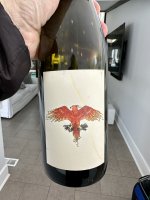
Are you referring to this? I understand she and a friend made this vermouth from her grapes because of smoke taint. It is fabulous!
Attachments
Jeff Grossman
Jeff Grossman
The red phoenix label is the vermouth; the white phoenix label is the blanc de noirs. ETA: 70% blanc de noir, 30% chardonnay.
scottreiner
scott reiner
Aha! I'll have to try that.