Here's to hoping this adds something useful to the range of opinions on Cornelissen wines. When this arrived a few months ago, I decided to stand one up and see just to what extent it would settle and clarify. It's my pet conviction that doing so allows these wines to show their best. Of course, it's time consuming and not convenient at all.
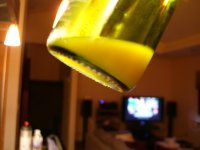
Every now and then I would hold it up to the cellar light and check for progress. It was subtle, but it was getting less hazy. Finally I decided I had to pop this Nomacorc and see what was under it. So like a monk with a fragile chalice, I brought it up, lightly chilled it, and then poured it off the sediment.
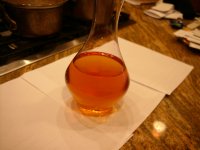
What I got was a brilliant amber with nice clarity. As with other Cornelissen wines I've opened, initially this was high strung, skittish and nervy. Pent up, awkward and volatile (of course), it needed about 30 mins to begin to settle down. Vivid citric acidity, oxidation, apricots and tannin dominate to start. As this evolves, the disjointed components that blare begin to relax and come together a bit. The sheer intensity says "young". It reminds me of two very different things, the oxidation and acidity remind me of some oxidized white burgundies, which get cursed as they are dumped, and also of an 1860s Madeira Malvasia I had a few years ago, only lighter. The tannins have that Etna firmness that I've come to recognize in all the Cornelissen wines I've had.
It's now nearly 3 hours from opening and it continues to coalesce. The various elements fitting together and new complexities are emerging. The firmness is mellowing. It's been educational to follow the development but I'm ready to say that one could easily let this sit for two hours before diving in and not really miss anything. I've got about a quarter of the bottle left and we're both getting good now. Which reminds me that this does carry some alcohol. It's labeled as 13%. That might be a little low.
My first experience of a Cornelissen orange (Munjebel 3) was at last summers West Coast Orange Wine dinner. It didn't win much praise but I believe it required very special handling and that wasn't possible in that situation. I made a note then that when given the chance, I would test my theory on handling.
While not definitively conclusive, for me this adds more proof to my belief that if you don't handle these right you will not get the best possible experience.
I see that this is now a pretty extensive note for one wine, if you've made it to here, please excuse the indulgence.


Every now and then I would hold it up to the cellar light and check for progress. It was subtle, but it was getting less hazy. Finally I decided I had to pop this Nomacorc and see what was under it. So like a monk with a fragile chalice, I brought it up, lightly chilled it, and then poured it off the sediment.
What I got was a brilliant amber with nice clarity. As with other Cornelissen wines I've opened, initially this was high strung, skittish and nervy. Pent up, awkward and volatile (of course), it needed about 30 mins to begin to settle down. Vivid citric acidity, oxidation, apricots and tannin dominate to start. As this evolves, the disjointed components that blare begin to relax and come together a bit. The sheer intensity says "young". It reminds me of two very different things, the oxidation and acidity remind me of some oxidized white burgundies, which get cursed as they are dumped, and also of an 1860s Madeira Malvasia I had a few years ago, only lighter. The tannins have that Etna firmness that I've come to recognize in all the Cornelissen wines I've had.
It's now nearly 3 hours from opening and it continues to coalesce. The various elements fitting together and new complexities are emerging. The firmness is mellowing. It's been educational to follow the development but I'm ready to say that one could easily let this sit for two hours before diving in and not really miss anything. I've got about a quarter of the bottle left and we're both getting good now. Which reminds me that this does carry some alcohol. It's labeled as 13%. That might be a little low.
My first experience of a Cornelissen orange (Munjebel 3) was at last summers West Coast Orange Wine dinner. It didn't win much praise but I believe it required very special handling and that wasn't possible in that situation. I made a note then that when given the chance, I would test my theory on handling.
While not definitively conclusive, for me this adds more proof to my belief that if you don't handle these right you will not get the best possible experience.
I see that this is now a pretty extensive note for one wine, if you've made it to here, please excuse the indulgence.