Munjebel 4 Arancione

Ned Hoey

Ned Hoey
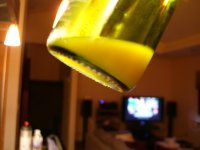
Here's to hoping this adds something useful to the range of opinions on Cornelissen wines. When this arrived a few months ago, I decided to stand one up and see just to what extent it would settle and clarify. It's my pet conviction that doing so allows these wines to show their best. Of course, it's time consuming and not convenient at all.

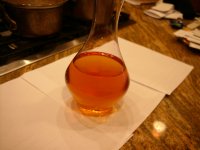
Every now and then I would hold it up to the cellar light and check for progress. It was subtle, but it was getting less hazy. Finally I decided I had to pop this Nomacorc and see what was under it. So like a monk with a fragile chalice, I brought it up, lightly chilled it, and then poured it off the sediment.

What I got was a brilliant amber with nice clarity. As with other Cornelissen wines I've opened, initially this was high strung, skittish and nervy. Pent up, awkward and volatile (of course), it needed about 30 mins to begin to settle down. Vivid citric acidity, oxidation, apricots and tannin dominate to start. As this evolves, the disjointed components that blare begin to relax and come together a bit. The sheer intensity says "young". It reminds me of two very different things, the oxidation and acidity remind me of some oxidized white burgundies, which get cursed as they are dumped, and also of an 1860s Madeira Malvasia I had a few years ago, only lighter. The tannins have that Etna firmness that I've come to recognize in all the Cornelissen wines I've had.

It's now nearly 3 hours from opening and it continues to coalesce. The various elements fitting together and new complexities are emerging. The firmness is mellowing. It's been educational to follow the development but I'm ready to say that one could easily let this sit for two hours before diving in and not really miss anything. I've got about a quarter of the bottle left and we're both getting good now. Which reminds me that this does carry some alcohol. It's labeled as 13%. That might be a little low.

My first experience of a Cornelissen orange (Munjebel 3) was at last summers West Coast Orange Wine dinner. It didn't win much praise but I believe it required very special handling and that wasn't possible in that situation. I made a note then that when given the chance, I would test my theory on handling.
While not definitively conclusive, for me this adds more proof to my belief that if you don't handle these right you will not get the best possible experience.

I see that this is now a pretty extensive note for one wine, if you've made it to here, please excuse the indulgence.

L1000667.jpg
L1000672.jpg
L1000674.jpg
 

Attachments

  • L1000667.jpg
    L1000667.jpg
    483.5 KB · Views: 0
  • L1000672.jpg
    L1000672.jpg
    543.9 KB · Views: 0
Great play by play, Ned. Only one question....you left me hanging at, "It's nearly 3 hrs now and continuing to coalesce." I was on the edge. Coalesce into....? I would think these wines might tend to shape shift heavily. Did it move into something reminiscent of other than oxi'd burg or 1860's madeira?
 
originally posted by Joel Stewart:
Great play by play, Ned. Only one question....you left me hanging at, "It's nearly 3 hrs now and continuing to coalesce." I was on the edge. Coalesce into....? I would think these wines might tend to shape shift heavily. Did it move into something reminiscent of other than oxi'd burg or 1860's madeira?

Yes, sorry for that. Those component elements didn't really disappear entirely. They blurred and melted together. Imagine those distinct angular elements losing their harsh unpleasant aspects and blending to form more interesting, balanced ones. Citrus skins and oils, nuts, marmalade, spices. The oxidation considered a terrible flaw in white Burgs does carry with it aspects that are valued in other contexts. Oxidative notes like these are not considered acceptable or appropriate in such young wines yet they can be compelling with the added dimensions that skin contact brings. Orange wines present such atypical aromas and flavors, I guess I'm a little over matched at communicating them.
 
originally posted by Ned Hoey:
It reminds me of two very different things, the oxidation and acidity remind me of some oxidized white burgundies, which get cursed as they are dumped, and also of an 1860s Madeira Malvasia I had a few years ago, only lighter. The tannins have that Etna firmness that I've come to recognize in all the Cornelissen wines I've had.

So here's the million dollar question. While I like and admire Madeira and many Sherries, is this a wine that speaks to terroir or vinification/lvage?

My contention is that as much as I like some of the wines, i think the extreme versions are a bridge too far and miss the point of wine as terroir expression. At the prices asked for many of these wines, expression of terroir is what I expect. In fact, I'd go so far as to say that's what I expect not just from expensive wine, but from great wine.

Is this more than a curiosity? Does it tell you something about Etna or just about Cornelissen? The latter is fine too (and maybe person and geography are harder to separate than we might think), but it misses the mark for me and is something, like 17% zinfandel, that might not interest us much in 20 years.
 
is a wine that is (almost) completely non-manipulated - no additives, no racking, bottled straight from the amphora - a better expression of terroir? It would seem, on the surface, to be so.

I think that we are used to the results and flavors of current winemaking "standards". Is a wine that follows none of those standards too weird to enjoy? Are our palates too conservative? Is an unobstructed view of a terroir too much information?

I remember tasting two bottles of 1982 Bandol at Tempier - one was filtered, the other was not. Everyone (the Peyrauds included) preferred the filtered wine. It was more familiar and comfortable. Everyone wanted to like the unfiltered wine, because, you know, "unfiltered is better", but we had to admit we enjoyed the flavors of the more manipulated wine more. At least on that day.
 
I think what VLM is saying (since I've discussed this with him before) is that certain non-interventionist styles of wine can reduce any terroir characteristics simply by the fact that they are so fucked when we finally get them. In some cases this is certainly true as i've had wines from afew producers that don't taste like much of anything except natural winemaking. Other wines, say from Overnoy-Houillon, can be fantastically complex and not marked (except a little co2) From my experience Cornelissen's wines can taste like Sicilian wines for roughly two minutes in the glass, after that it's time for something else.

Or what Guilhaume said.

Guilhaume's anecdote about a natural producer in the Jura mistaking a gamay from Auvergne for a Poulsard he made is telling.
 
originally posted by guilhaume:
vin naturel=vin spoof

that would make a good bumper sticker. Or translate it into french for me and I'll put it on one of my labels.

Your zen-like post implies a line somewhere between the two, or a point at the center of the circle. How do you define that?
 
Guilhaume's anecdote about a natural producer in the Jura mistaking a gamay from Auvergne for a Poulsard he made is telling.

and embarassing!

Who sets the standard? Is there a standard? Are we looking for typicity here?

When does technique begin?

Or is it a case that sometimes, for some unknown reason, the wine and terroir transcend the winemaker?
 
originally posted by Hank Beckmeyer:
Or is it a case that sometimes, for some unknown reason, the wine and terroir transcend the winemaker?

Cuve Frederich Emile and Clos St. Hune
 
originally posted by VLM:
originally posted by Hank Beckmeyer:
Or is it a case that sometimes, for some unknown reason, the wine and terroir transcend the winemaker?

Cuve Frederich Emile and Clos St. Hune
Yah, I brought CSH to the natural wine forum just to challenge everyone's position after the debate.
 
originally posted by VLM:
originally posted by Hank Beckmeyer:
Or is it a case that sometimes, for some unknown reason, the wine and terroir transcend the winemaker?

Cuve Frederich Emile and Clos St. Hune

Are the other Trimbach cuvees spoofy? I thought Trimbach was generally considered a pretty worthwhile producer, and not just CFE and Clos St. Hune.

Though I did hear that Clos St. Hune, at the very least, is vinified in a different manner than Trimbach's other wines.
 
originally posted by Cory Cartwright:
The clos st. hune was an excellent and pricey way to make a point Joe, thanks for that.

Was it a '95?
That is my recollection.

They used to be cheaper than they are now.
 
originally posted by Hank Beckmeyer: I think that we are used to the results and flavors of current winemaking "standards". Is a wine that follows none of those standards too weird to enjoy? Are our palates too conservative? Is an unobstructed view of a terroir too much information?

This doesn't make sense.

Too much of natural wine from too diverse a range of terroirs and grapes tastes too similar.
 
originally posted by Yule Kim:
originally posted by VLM:
originally posted by Hank Beckmeyer:
Or is it a case that sometimes, for some unknown reason, the wine and terroir transcend the winemaker?

Cuve Frederich Emile and Clos St. Hune

Are the other Trimbach cuvees spoofy? I thought Trimbach was generally considered a pretty worthwhile producer, and not just CFE and Clos St. Hune.

Though I did hear that Clos St. Hune, at the very least, is vinified in a different manner than Trimbach's other wines.

Not spoofy exactly.

To paraphrase Eric, these wines are proof that terroir exists. Even crappy industrial vinegrowing and winemaking cannot destroy them.
 
originally posted by SFJoe:
originally posted by Cory Cartwright:
The clos st. hune was an excellent and pricey way to make a point Joe, thanks for that.

Was it a '95?
That is my recollection.

They used to be cheaper than they are now.

Ah, the good old days.
 
Back
Top