Frank and his tanks (Anfore)

originally posted by MLipton:
originally posted by kirk wallace:


How about this? Bring back any memories?

Nope, never saw the work in question when I was in Rome (perhaps I was doing as the Romans do?) I have no trouble seeing the emotional excess that Joel alluded to in this work, but question if its anything specific to Bernini, as it seems more a sign of the times. With greater realism in Renaissance art came more realistic depiction of the religious fervor that had perfused artistic depiction for many centuries. A comparison of that work with, e.g. da Vinci's "Adoration of the Magi" leaves me with the impression that Bernini was more adept at conveying emotion in his work, but not with any signficant difference in intent.

Just my 5 lire,
Mark Lipton

Mark, I agree in that Bernini wasn't alone in intent...he was just an easy example to bring up in the context of my explaining to Brezeme why I took his remark about Cornelissen's wines being "Baroque" the way I did. I mentioned Ruben's paintings as well as examples of overblown excess and drama. (Doesn't mean I don't admire aspects of their work, mind you.)Brezeme was referring to his take on the philosophy underlying the period...I was referring to my take on the style of the arts of the period. We were not talking about the same thing after all. This was the original context.

I too was in the Borghese,in 1999...I was seeking an audience with Carravaggio's Sick Bacchus (and had other "appointments" the following several days with Carravaggio's paintings all over Rome...that was how I beat Stendalismo. Carravaggio refreshed me...everywhere I went, every damn painting.)I walked by Bernini's Rape of Proserpina and nearly sneered at it's technical prowess. (See how the fingers dig into her flesh?)I was unmoved by the sculpture...just too intent on wowing, for one, and secondly, stylistically too precise for me. Cold, white marble. I was headed to look at a painting where I could see brush strokes and a green pallor. Weird, imperfect, human, and not cut from the same cloth at all.

Of course, this is also a matter of interpretation (my own as well as the artist's). Plenty of Carravaggio's works had high drama to them (though not nearly as much visual excess, which is key to my enjoyment of his work)...he just turned up the screws in different ways. To me, less melodramatic, grittier and thus more alive for my tastes. Plus his handling of the paint. Wow. Economy, not excess.

Just a long winded way of saying that my point of view on most of the art of the Baroque is infused mostly by personal taste than anything else...
 
originally posted by Levi Dalton:
Basically and to oversimplify, what happened between Leonardo and Bernini was Caravaggio.
A footnote on the personal violence front: Caravaggio's first public success was in 1600. Wikipedia continues:

"In 1606 he killed a young man in a brawl and fled from Rome with a price on his head. In Malta in 1608 he was involved in another brawl, and yet another in Naples in 1609, possibly a deliberate attempt on his life by unidentified enemies. By the next year, after a relatively brief career, he was dead."
 
originally posted by Brzme:

Including '05 Pergaud, and last thursday Allemand's Chaillot . A total waste.

A minor footnote to a fascinating thread. I had the '01 Reynard from Allemand last night. I thought it was perfect, although I might prefer my Allemand Cornas on the slightly youthful side of ready compared to some (the '98s are still drinking well, but might have been just a little better 2-3 years ago?).
 
originally posted by Jeff Grossman:
originally posted by Levi Dalton:
Basically and to oversimplify, what happened between Leonardo and Bernini was Caravaggio.
A footnote on the personal violence front: Caravaggio's first public success was in 1600. Wikipedia continues:

"In 1606 he killed a young man in a brawl and fled from Rome with a price on his head. In Malta in 1608 he was involved in another brawl, and yet another in Naples in 1609, possibly a deliberate attempt on his life by unidentified enemies. By the next year, after a relatively brief career, he was dead."

Of course Caravaggio is the Crown Prince of this sort of thing. There were several assaults and he at one point killed a man with his sword after arguing the score of a tennis match.

For me, Caravaggio is still the reigning champ, over such other worthies as Christopher Marlowe (who worked as a spy and was killed by a knife blade to the eye), Alfred Jarry (who carried two revolvers in his belt while cycling through 19th century Paris and who once attacked Proust with a knife), Bernini (who would have killed his brother if Luigi had not hid in the church of Santa Maria Maggiore), and Jacques-Louis David.

Jacques-Louis David earned his place in the lineup about 5 years after painting this

Lavoisier-1.jpg
portrait, considered today one of the greatest portraits of the 18th century. The piece, completed in 1788, is entitled Portrait of Monsieur Lavoisier and His Wife, and depicts the chemist Lavoisier and his wife Marie-Anne Pierette Paulze. Antoine Lavoisier had successfully determined the composition of water and synthesized the compound from its elements in 1783, and was thus the first person to do so. He also helped construct the metric system, amongst other worthy feats. Lavoisier was a wealthy man, and had been able to send his wife to David for instruction in drawing, as well as pay David a record sum of 7,000 livres for the above portrait. David returned the favor by making advances on Marie-Anne Paulze, which were apparently rejected. In 1793 David went about signing death warrants for both Antoine Lavoisier and Jacques Paulze (Marie-Anne's father) as part of his role for the Committee of Public Safety. Both men were guillotined, and Lavoisier's possessions were confiscated, leaving Marie-Anne penniless.

The portrait now hangs in the Metropolitan Museum, Manhattan.
 
originally posted by Joel Stewart:

Mark, I agree in that Bernini wasn't alone in intent...he was just an easy example to bring up in the context of my explaining to Brezeme why I took his remark about Cornelissen's wines being "Baroque" the way I did. I mentioned Ruben's paintings as well as examples of overblown excess and drama. (Doesn't mean I don't admire aspects of their work, mind you.)Brezeme was referring to his take on the philosophy underlying the period...I was referring to my take on the style of the arts of the period. We were not talking about the same thing after all. This was the original context.

I too was in the Borghese,in 1999...I was seeking an audience with Carravaggio's Sick Bacchus (and had other "appointments" the following several days with Carravaggio's paintings all over Rome...that was how I beat Stendalismo. Carravaggio refreshed me...everywhere I went, every damn painting.)I walked by Bernini's Rape of Proserpina and nearly sneered at it's technical prowess. (See how the fingers dig into her flesh?)I was unmoved by the sculpture...just too intent on wowing, for one, and secondly, stylistically too precise for me. Cold, white marble. I was headed to look at a painting where I could see brush strokes and a green pallor. Weird, imperfect, human, and not cut from the same cloth at all.

Of course, this is also a matter of interpretation (my own as well as the artist's). Plenty of Carravaggio's works had high drama to them (though not nearly as much visual excess, which is key to my enjoyment of his work)...he just turned up the screws in different ways. To me, less melodramatic, grittier and thus more alive for my tastes. Plus his handling of the paint. Wow. Economy, not excess.

Just a long winded way of saying that my point of view on most of the art of the Baroque is infused mostly by personal taste than anything else...

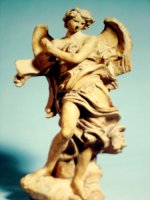
Some years ago the Fogg Museum at Harvard University held an exhibit called Sketches in Clay where they showed 15 terracotta statuettes linked directly to Bernini.

Bernini_1.jpg
Bernini_2.jpg
The pieces were rough drafts sketches for sculptural works that Bernini was planning. I attended the show and found the statuettes arresting. The sweep of a rough garment, the pressed imprint of a thumb for eyes, one felt that Rodin could have learned a trick or two from these small beauties.

Bernini of course was a fluid genius. He choose to work as he did, but with his skill set could easily have gone another way.

That being said, I saw this

Caravaggio.jpg
when it travelled to Boston some time ago, and that was an arresting experience.
 

Attachments

  • Bernini_1.jpg
    Bernini_1.jpg
    88.9 KB · Views: 0
originally posted by Joel Stewart:
I too was in the Borghese,in 1999... I was unmoved by the sculpture...just too intent on wowing, for one, and secondly, stylistically too precise for me. Cold, white marble.

Funny, I had a case of the opposite: the mattress on which Pauline Bonaparte lies is SO succulent that I had to be restrained from sinking my teeth into it (would have been quite painful). Oddly, Canova made the mattress far more succulent than the subject, as if desire had been displaced from the contained to the container.

Pauline_Buonaparte.jpg
Pauline Buonaparte, Antonio Canova, Palazzo Borghese
 
originally posted by Oswaldo Costa:
originally posted by Joel Stewart:
I too was in the Borghese,in 1999... I was unmoved by the sculpture...just too intent on wowing, for one, and secondly, stylistically too precise for me. Cold, white marble.

Funny, I had a case of the opposite: the mattress on which Pauline Bonaparte lies is SO succulent that I had to be restrained from sinking my teeth into it (would have been quite painful). Oddly, Canova made the mattress far more succulent than the subject, as if desire had been displaced from the contained to the container.

Pauline_Buonaparte.jpg
Pauline Buonaparte, Antonio Canova, Palazzo Borghese

That is so perfect, Oswaldo. I have always been puzzled by that sculpture; and always noted how inviting the cushion/mattress looks and how bland the Princess. Now I can put it together - and take conmfort that it's not just I who have this reaction.

I will say, to Levi's bringing Caravagio in here, is that the Bernini sculptures were helped tremendously at my last visit to the Borghese by all the Carravagio's that they had scattered about for the Caravagio/ Bacon show.

Especially this one, which they had borrowed from the Doria Pamphilij:

caravpenitmagd.jpg
 
Levi...those are interesting pics of the terracotta sketches by Bernini. The Accademia in Florence has a few interesting ones as well by other sculptors (forget who did the Rape of the Sabines one, the original which stands in the square). Terracotta is certainly more pliable and immediate, as your pics show...that would have been a wonderful show to see. Funny you mention Rodin, his work also fascinates me...I suspect Rodin saw Michelangelo's "Prisoners" too, don't you?...and some say he lifted things not only from his mistress, but also his contemporary, the Italian sculptor Medardo Rosso, whose ethereal busts in beeswax I had the sheer luck of seeing in Tokyo 20 yrs ago.

I was looking at the detail shots of the R. of Proserpina sculpture online...I love the detail shot of her left foot...and in the end, I can find a lot of interest and sometimes pleasure from other details in the piece as well. I am for some reason less enamored with Pluto. It's almost as if that part of the sculpture was created with a computer graphics program...the lines and bulges feel mathematically "too correct", and the result is overly decorative and fake. Probably because it's trying so hard to impress. It's the same with a lot of CG dominant movies today: because they can show off this or that effect/technique, that ends up dominating the storyline all too often.

Anyone ever make it to the Bargello in Florence? Lot's of fun.

Oswaldo, you rascal, you misquoted me...I didn't say sculpture in general, I meant the Bernini piece..you knew that, right? True though, it was that teeny little Caravaggio that got me to make the long walk up the hill to the Borghese in the first place and I whizzed through most of the collection after that...so I actually missed the Canova, but totally agree on the mattress. Total displacement....though it was probably a vanity commission, right?

Kirk - Envious that you saw the C/Bacon show. I wasn't quite sure I followed the curatorial impetus for that, but I like both artists...so what the heck.

On a final note....what I love among other things about Rome is that many of the Caravaggios are still installed where they were originally meant to be. A significant body of his work can be seen on a looping walking route through the city that is pleasure in itself.
 
originally posted by Joel Stewart:

On a final note....what I love among other things about Rome is that many of the Caravaggios are still installed where they were originally meant to be. A significant body of his work can be seen on a looping walking route through the city that is pleasure in itself.

On the basis of my one visit, long ago, I would say that what I love about Rome is the ubiquity of fine art in all sorts of random sites as well as the arresting architecture of the city. As an aside, my impressions may very well be colored by our having stumbled, nearly literally, onto an open air performance by Keith Jarrett in the Piazza di Campidoglio one evening -- an experience that ranks high among many magical musical experiences in my life.

Mark Lipton
 
originally posted by Joel Stewart:


Kirk - Envious that you saw the C/Bacon show. I wasn't quite sure I followed the curatorial impetus for that, but I like both artists...so what the heck.

You would have been, I think, no more enlightened about the impetus for the show by seeing it; there was some forced commentary about "artists who made their audiences see reality, warts and flaw and dirt" or something like that, but I didn't (and this has been widely written about so I guess i am not alone) think there was all that much that one set of works added to the other. On the other hand, to get to see that many Caravaggios in one place was amazing and great fun. And they borrowed the Valasquez Innocent X from the Doria Pamphilij to pair with one of Bacon's version of it -- that was very interesting and cool. (And then seeing the pair of Bernini busts of Innocent X at the Doria Pamphilij the next day was a perfect coda.)
 
Kirk, nice to encounter a kindred soul. Would love to hear why the sleeping maid with the sumptuous skirt affected you so.

Joel, apologies, I did understand "the sculpture" to mean the kit & caboodle rather than the specific Bernini. Hambiguities of eenglish. Goodness gracious, I LUV Medardo Rosso! If anyone here doesn't know his work, please google image him. You'll be amazed. An avant la lettre manifestation of Georges Battaile's useful and very interesting category of the l'Informe.
 
originally posted by Joel Stewart:
Nice. I think the pairing of the Velasquez with the Bacon would have been an interesting sight, indeed.

As you know, Joel, everything is better with Bacon.

Mark Lipton
 
originally posted by MLipton:
originally posted by Joel Stewart:
Nice. I think the pairing of the Velasquez with the Bacon would have been an interesting sight, indeed.

As you know, Joel, everything is better with Bacon.

Mark Lipton

Damn! You're too quick!
 
originally posted by Oswaldo Costa:
Kirk, nice to encounter a kindred soul. Would love to hear why the sleeping maid with the sumptuous skirt affected you so.

Joel, apologies, I did understand "the sculpture" to mean the kit & caboodle rather than the specific Bernini. Hambiguities of eenglish. Goodness gracious, I LUV Medardo Rosso! If anyone here doesn't know his work, please google image him. You'll be amazed. An avant la lettre manifestation of Georges Battaile's useful and very interesting category of the l'Informe.

The repro does not do the painting much justice.

The sleeping girl w/sumptuous skirt is Mary Magdalene penitent.

While not one of Caravaggio's most dramatic paintings, it does have the ability to shake one's soul.

-K.
 
originally posted by Kevin McK:
originally posted by Oswaldo Costa:
Kirk, nice to encounter a kindred soul. Would love to hear why the sleeping maid with the sumptuous skirt affected you so.

Joel, apologies, I did understand "the sculpture" to mean the kit & caboodle rather than the specific Bernini. Hambiguities of eenglish. Goodness gracious, I LUV Medardo Rosso! If anyone here doesn't know his work, please google image him. You'll be amazed. An avant la lettre manifestation of Georges Battaile's useful and very interesting category of the l'Informe.

The repro does not do the painting much justice.

The sleeping girl w/sumptuous skirt is Mary Magdalene penitent.

While not one of Caravaggio's most dramatic paintings, it does have the ability to shake one's soul.

-K.

Right. MM Penitente. and the JPG definitely doesn't give even a pale shade of the original. In person, the painting is utterly arresting. And when one learns (at least I had never been told this before about it) that MM's dress and garb would be immediately recognizable to Romans at the time as that of a relatively high-priced prostitute, it makes all the more sense; and the cast aside jewelry -- one strand broken rather than unclasped -- an the luminous vial of (presumably) perfumed oil at her feet, makes the pain and exhaustion palpable.

All the more rich when one learns that it was Camillo Pamphilj who acquired the painting and that it was his mother, Olimpia Maidalchini Pamphilj -- sister-in-law to, and alleged paramour of, Innocent X -- who convinced Innocent X to have the Vatican give up the right to tax (and protect) Rome's brothels and to give that income stream to her and the Pamphilj family. She is reported to have greatly improved the conditions of Rome's prostitutes and to added greatly to the Pamphilj fortune. Olimpia was referred to as La Papessa for her reputed control over Innocent X.

This bust is said to be unflattering, but captures her "spirit":

Maidalchinibust.jpg
 
Back
Top