CWD: 2001 Rotllan Torra Amadis

drssouth

Stephen South
2001 Rotllan Torra Amadis DOQ Priorat, alc 13.5%...from an exclusive parcel of 100 year old vines of Grenache and Carignan. a blend of 45% Grenache and 20% Carignan from 90-100 year old vines, and the rest younger vine Cabernet Sauvignon, Syrah, and Merlotdecanted for 3 hrsnose of tobacco and a bit of leatherthe palate is a little soft but offers plums, dates and a little meatiness. the tannins are mostly resolvedthe finish is moderately longIf you have this, get to it sooner than later.

With Indian spiced braised pork shoulder curry over brown Basmati rice
 
Agree on the terroir vs. the results.

I've had a few good experiences with Rotllan Torra. Make that a couple of spectacular experiences. And a lot of terrible ones.

Soooo much potential there!
 
Rotllan Torra makes some of the dirtiest wines in Priorat. Most are a mass of different defects, with triumphant brett a common thread. Some miraculously go through and show well. Those seem to be the ones that got all the applause (less and less so these days, it seems) from the international gurus. At our blind tastings in Spain the results are usually catastrophic.

Lots of people make Priorat well. Lots of people make Priorat awfully. But dismissing the majority would be plainly unfair. You have to understand hot climate wines, though. Otherwise you'll always hate them. (Plus of course they are expensive, so that what would be a passable flaw in cheaper wines becomes pretty intolerable.)

FWIW, the main results from our recent tastings of current Priorat wines indicate some very good and even excellent wines are still being produced, and give us a clue to the worthy second- and third-generation producers (after the 'band of five' pioneers in 1989).

I'll spare you the points, which are forcefully repudiated on this bored...

Absolutely top of the pops: Les Tosses 2007 Terroir al Lmit (this is 100% carignan), Les Manyes 2007 Terroir al Lmit (100% grenache), L'Ermita 2007 Alvaro Palacios (100% grenache), Finca Dof 2007 Alvaro Palacios (55% grenache, 25% cabernet sauvignon, 20% syrah), Clos Erasmus 2007 Clos i Terrasses (90% grenache, 10% syrah), Somni 2007 Portal del Priorat (grenache, syrah, carignan).

Outstanding stuff: Dits del Terra 2007 Terroir al Lmit (100% grenache), Cirerets 2007 Mas Alta (50% carignan, 50% grenache), La Creu Alta 2007 Mas Alta (60% carignan, 40% grenache), Perpetual 2006 Torres (grenache, carignan), Idus 2007 Vall Llach (45% carignan, 15% grenache, 15% merlot, 15% cabernet sauvignon, 10% syrah).

Good wine at non-Priorat, affordable prices: Mas Vil 2005 Maset del Llo (65% grenache, 35% carignan), Marge 2007 Celler de l'Encastell (50% grenache, the rest merlot, syrah and cabernet sauvignon).

Below their reputation and/or usual level: Clos Mogador 2007, Vall Llach 2007 (actually, showing less well than Idus).
 
I do understand the hot climate and have visited the region. The hot climate has nothing to do with how long they let the grapes hang, the excessive oak treatment and the extraction in the winery. I am involved in a small wine project in the Roussillon which is similar to Priorat ten years ago and the climate is clearly a challenge but the vineyards are amazing.

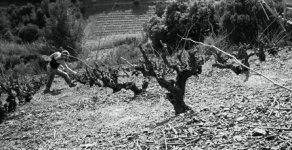
pruning_lermita1b-1.jpg
la_florine.jpg
Les Tosses 2007 Terroir al Lmit is only $250...unfortunately too expensive to give it a try.

I will keep buying Cims and older dirty Rotllan Torra's at auction for $30-50.
 

Attachments

  • pruning_lermita1b-1.jpg
    pruning_lermita1b-1.jpg
    122.6 KB · Views: 0
originally posted by Robert Dentice:
The hot climate has nothing to do with how long they let the grapes hang, the excessive oak treatment and the extraction in the winery. $30-50.
Exactly. These are the people who do Priorat badly. Similar to the people who do Roussillon badly - or Bandol or Manchuela badly.
 
Victor from your list it seems that many of those wines are of the extremely ripe and quite oaky camp. I will admit that I haven't had many of the individual bottles in question, but I've had enough bottles from Vall Llach, Terroir al Limit and Mas Alta to stop giving any more money to any of them. I've never like the Palacios wines, I've always found them lacking aromatically and seemingly very extracted. I used to be a big fan of Erasmus but so ripe from 03-06 that I've stopped trying.

I've like a few Mas Doix wines quite well when they aren't over acidulated. I've liked a lot of Clos Mogador vintages and several Martinet vintages. A few big successes with Rotllan as mentioned but a lot of misses too.

Not trying to nit pick your list, everyone likes what they like, but for my tastes most of your list fits your own comment of "These are the people who do Priorat badly."

I have yet to find a single producer though whose wine could be described as fresh or pure or unencumbered. Such things exist in the Languedoc, Roussillon, Chateauneuf (though barely any more) and Bandol. Are there any in Priorat? It's a genuine question, you know it better than most / all. Is anyone using mostly neutral oak or concrete and picking fruit that retains some freshness and handling gently in the winery?
 
No, Josh, you obviously haven't tasted much from such producers as Eben Sadie and Dominik Huber of Terroir al Lmit - your descriptions would signal an absolutely non-existent tasting ability if you had really tasted these subtle wines before defining them as very oaky and over-extracted. Also, a statement that Alvaro Palacios' wines are particularly "lacking" in aromatics is rather incomprehensible to me. They certainly aren't.

Let me re-state first that this list is not "my" list but the result of a large blind tasting by the most respected, least-Parkerized tasting team in Spain, that of elmundovino, which includes several committed (but not too dangerous) fundamentalists who safeguard us from any oak and general spoofulation cravings we might fall prey to.

That said, most of us here don't share the berfundamentalist approach that 30 year-old oak vats or concrete containers are the only way to condition a red wine destined to a long and interesting evolution in bottle (because the raw materials warrant and merit such a long life, not because the winemaker wants to disguise them into what they aren't). Newish (not necessarily new, of course) oak barrels provide a crucial micro-oxygenation during 'levage' which favors tannin polymerization, so they are an excellent tool for a conscientious winemaker who aims for age-worthiness. Then it becomes a question of balance and of oak integration. If there is enough solid extract, structure and fruit in the wine, they will absolutely take over over time, when the wine reaches its drinking window.

Several of these young, 2007 Priorats are still on their way there, but to a bunch of experienced tasters they are clearly on the right course.

I must insist: there is around these parts a general misunderstanding of the terroirs in eastern Spain, not just in Priorat, even vis--vis wines that are not at all treated with the usual over-extraction techniques in the cellar (hot, protracted fermentation; post-fermentation maceration), but are routinely termed "over-extracted" or "spoofed".

Heck, I know how I make MY wines, and I have to shake my head in disbelief when I read one of this board's participants describe one of them thusly: "Smells & tastes like the grapes were crushed by an elephant. I have rarely had anything so extracted that didn't come from Napa or Australia. I might pick it blind as Syrah (on second thought, maybe not), but would not have any idea where it came from." (That last sentence at least is comprehensible to me: he's never had any other wines from that region of the world...)

These preceptions, to me, are akin to not understanding the terroir effect in our part of the world at all. Also, a basic ignorance of viticulture and the effect that weather conditions have on it and on the ensuing vinification process. For instance, in your case, the mention of Erasmus being "so ripe from 03-06" is revealing. Daphne Glorian did not change her winemaking methods or her choices for the right moment to pick the grapes one iota in 2003, in 2004 or in 2006. But her wines, like anyone else's, reflect the vintage. And they reflect Priorat.

You don't have to like hot-climate wines. But you don't have to dismiss them for the wrong reasons, those of imaginary over-manipulation, either.
 
Probably, we should all complete a comprehensive terroir and wine-making course before writing notes, even at the hack amateur level. It's an unjust world. Thanks for your remarks, though - every bit of education helps.
 
Be as derisive as you want, Ian, but do stop for a second to reflect on this:

Producers from such places as Priorat or Jumilla are regularly lambasted for over-extracting and spoofing their wines, while those from the Loire or the Jura are not, as they are seen as paragons of winemaking virtue. Doesn't it seem strange to you that in those warm parts of the world where wine is naturally powerful, concentrated, dense, the winemakers would be so foolish to go even further, to over-do everything? And in those cool and damp places where grapes often ripen with difficulty and tend to give thin wines with a vegetal streak, the winemakers are zen practitioners who just stand back and let nature run its course? Isn't it likelier to think that there are no more or less sinners in one part or in the other, that good winemakers in hot climates have no particular incentive to over-extract or over-ripen, and good winemakers in cold climates have all the incentives to coax as much expression and ripeness from their musts as they can?

Most wines that are not industrial wines reflect their terroir much more than they reflect the whims or excesses of their winemakers. Of course the terroir and the climate may seem much too overbearing for someone's tastes. But don't think that Jean-Michel Grin of Cte Rtie or Laurent Combier of Crozes-Hermitage would make an un-Priorat kind of Priorat if they went to Priorat.

Wait - Jean-Michel and Laurent already ARE in Priorat. Have you tasted Trio Infernal? Doesn't taste like Cte Rtie, huh?
 
CdP has been extolled by the most powerful wine writer in the world like no other region in the world (not even Bordeaux) has. So if there's one place where overdoing things may be somewhat more common than anywhere else - yes, that place is CdP. That said, is the percentage of actual spoofers as high as some claim? Will we give a number of those young showy wines, full of the usual grenache alcohol contents, the chance to show their stuff at age 7-10 before passing a definitive judgment? Because a few of them do seem to me to be real wines. Not all, of course.
 
I'll let you try them (and buy them!) and report back. I still have a few old bottles in the cellar that should hold me while the new experiment runs.

And people who know better than I blame syrah for alcohol, color, and OTTness as much as grenache.
 
Syrah in CdP (as elsewhere) usually has from 1% to 2% less alcohol than grenache, which is by far the most alcoholic of the quality red grapes of the world - i.e., it has more sugar than any other. On the color thing, that modern deviation which states that a wine must be light-colored to be good can only make me smile. Color means anthocyanins and it means an ability to age better. Then again, let's face it - grenache counts for 72% of the total surface of CdP and syrah only 10%, and syrah represents a very small amount of most wines. Syrah was basically a fashion in the 1970s-80s, when a lot was planted, but over the past decade many producers have become disillusioned, since syrah at sea level (which means warm summer nights at this latitude) tends to produce jammy, diffuse wines. So they're all cranking up the grenache again (and some mourvdre and counoise). That means, of course, more CdP fruit... but more alcohol again.
 
originally posted by VS:
Be as derisive as you want, Ian ...

You misunderstand. It is a pleasure to read analyses by those who know the particulars of their subject matter from first-hand experience, and hard not to feel humbled in the process.
 
originally posted by Ian Fitzsimmons:
Probably, we should all complete a comprehensive terroir and wine-making course before writing notes, even at the hack amateur level. It's an unjust world. Thanks for your remarks, though - every bit of education helps.

If you're going to write a tasting note, fine, go ahead and be completely ignorant of the subject. Maybe even admit it. But if you're going to make statements as fact, especially critical ones that are based on weak knowledge of the subject, then be ready to be called out for the dumbass that you are. Is that really that hard to understand?
 
originally posted by JSchwartze:
Yes, You Should
originally posted by Ian Fitzsimmons:
Probably, we should all complete a comprehensive terroir and wine-making course before writing notes, even at the hack amateur level. It's an unjust world. Thanks for your remarks, though - every bit of education helps.

If you're going to write a tasting note, fine, go ahead and be completely ignorant of the subject. Maybe even admit it. But if you're going to make statements as fact, especially critical ones that are based on weak knowledge of the subject, then be ready to be called out for the dumbass that you are. Is that really that hard to understand?

WTF? Are you venting pent-up rage because I disagreed with your 'trash-talking' comment in June? (Your last sentence is lifted from that thread). Or are you just naturally choleric?
 
Victor makes a good point about climate.

I have a question about elevation. IIRC, there is a fairly wide range, would it be possible to make a more linear and structured style of wine that is an "honest" expression of the terroir from those sites?

If someone is already doing that, could you name names?
 
Back
Top