
Oswaldo Costa
Oswaldo Costa
While visiting San Francisco at the turn of the year I visited SF MoMA as part of routine kulchur rounds and was intrigued to find an exhibition called "How Wine Became Modern: Design + Wine 1976 to Now." As both a finicky member of an ingrown, insular (oenological) community of like-minded zealots and someone who has followed contemporary art, architecture and design for almost forty years, I cringed at the prospect of pet interests doubly mangled. Instead, I came away won over by, and highly impressed with, the research scope of curator Henry Urbach and the inventiveness of the exhibition design, a collaboration with Elizabeth Diller, principal in the hip architectural firm of Diller, Scofidio & Renfro.
Apparently, the project was several years in the making, and so consumed its funding that no catalogue is forthcoming. A shame, since this substantial and original effort deserves to be properly documented (there is, at least, a positive NYTimes review here).
In the absence of a catalogue, I am posting some pictures of the exhibition and urge you to go see it if you’re near the Bay Area before April 17, when it closes.
Because of the museum context, at first I thought the exhibition title was using the word "modern" as an art historian might, to refer to stylistic visual aspects, such as the graphic design of bottle labels, the industrial design of wine paraphernalia, and the trophy architecture of modern wineries. But the exhibition covers much more ground, tackling contentious issues that pit modernists against traditionalists, or the latter's allies, the natural wine movement. It opens with an amusing photographic recreation of the Judgment of Paris (reproduced in the NYT link), that most misleading of supposed milestones, but a good ground zero for a shift in taste towards sweet, jammy, oaky, super-extracted, velvety wines. This kick-off, and other clues, suggest that Urbach is (also) using the term "modern" as wine geeks might, to refer to the shift in palate that coincided with (or resulted from) the popularization of point scores. And it's probably no coincidence that the expression "international style," like the word "modern," also has twin art historical and oenological meanings. Urbach doesn't appear to take sides in the debate - there are quotes from both sides of the modern/traditional wine divide - but presents a nuanced survey of several of the issues involved.
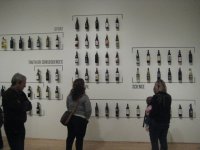
There is a room showing the different types of wine label subject matter:
 Close ups:

 Nuanced wall text:
 An "actual size" sculpture of a Romanée-Conti magnum:
 A recreation of a grafted vine, split into two parts, to show how it’s done:
 There is a display of wine glasses, covering all the Riedel shapes, plus some whimsical designs:
 There is a wall of wine-related scents, some notorious, like cat-pee, generated by squeezing what looked like old automobile horns:
 There is a terrific room of pictures and maquettes of architectural projects by leading architectural firms (missing is a beautiful winery built by Andreas Burghardt for Niepoort). Unfortunately, the artisanal wineries favored by geeks don’t have the cash to build these, so we are left to feel miserable on their behalf when faced with astonishing projects such as Herzog & de Meuron’s for Dominus in Napa, a winery encased in caged rocks).
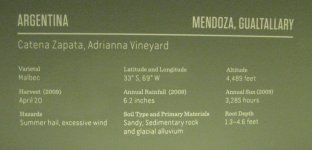
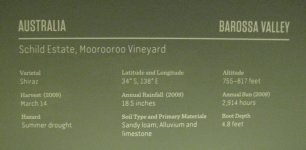
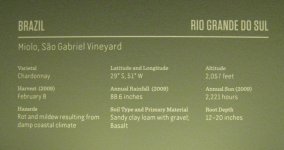
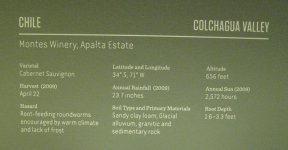
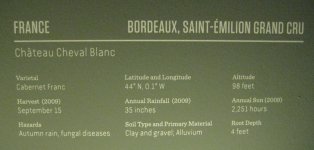
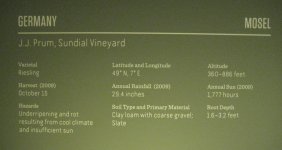
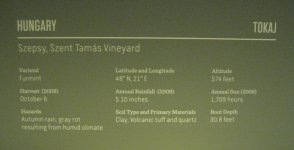
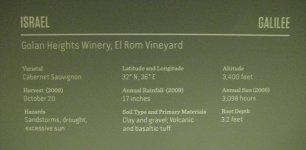
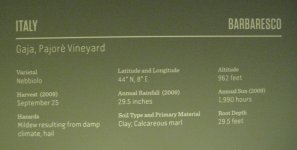
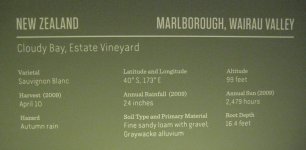
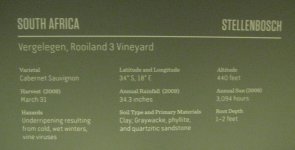
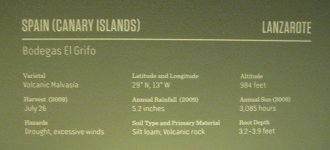
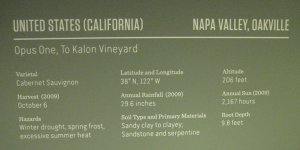
Finally, I was most fascinated by a room showing the characteristics of several wines and their vineyards, selected from around the world, so wildly inclusive that even Brazil is present. For each, there is the latitude, the harvest date, the hazards, the rainfall, the soil type, the altitude, the sunlight hours, and the root depth. It should be possible to run a multiple regression through these statistics, or perhaps use a neural net, to better understand what structural conditions generate the kinds of wine each of us like. I found these so interesting that I will reproduce them all, poorly captured by my pocket camera in low light without flash (as mandated by museum rules):


Apparently, the project was several years in the making, and so consumed its funding that no catalogue is forthcoming. A shame, since this substantial and original effort deserves to be properly documented (there is, at least, a positive NYTimes review here).
In the absence of a catalogue, I am posting some pictures of the exhibition and urge you to go see it if you’re near the Bay Area before April 17, when it closes.
Because of the museum context, at first I thought the exhibition title was using the word "modern" as an art historian might, to refer to stylistic visual aspects, such as the graphic design of bottle labels, the industrial design of wine paraphernalia, and the trophy architecture of modern wineries. But the exhibition covers much more ground, tackling contentious issues that pit modernists against traditionalists, or the latter's allies, the natural wine movement. It opens with an amusing photographic recreation of the Judgment of Paris (reproduced in the NYT link), that most misleading of supposed milestones, but a good ground zero for a shift in taste towards sweet, jammy, oaky, super-extracted, velvety wines. This kick-off, and other clues, suggest that Urbach is (also) using the term "modern" as wine geeks might, to refer to the shift in palate that coincided with (or resulted from) the popularization of point scores. And it's probably no coincidence that the expression "international style," like the word "modern," also has twin art historical and oenological meanings. Urbach doesn't appear to take sides in the debate - there are quotes from both sides of the modern/traditional wine divide - but presents a nuanced survey of several of the issues involved.
There is a room showing the different types of wine label subject matter:
Finally, I was most fascinated by a room showing the characteristics of several wines and their vineyards, selected from around the world, so wildly inclusive that even Brazil is present. For each, there is the latitude, the harvest date, the hazards, the rainfall, the soil type, the altitude, the sunlight hours, and the root depth. It should be possible to run a multiple regression through these statistics, or perhaps use a neural net, to better understand what structural conditions generate the kinds of wine each of us like. I found these so interesting that I will reproduce them all, poorly captured by my pocket camera in low light without flash (as mandated by museum rules):
Attachments
-
 Diversos_149-1.jpg189.1 KB · Views: 0
 -
 Diversos_134.jpg127.6 KB · Views: 0
 -
 Diversos_143.jpg131.6 KB · Views: 0
 -
 Diversos_130.jpg143.3 KB · Views: 0
 -
 Diversos_135.jpg144 KB · Views: 0
 -
 Diversos_133.jpg135.4 KB · Views: 0
 -
 Diversos_146.jpg145.4 KB · Views: 0
 -
 Diversos_140.jpg138.1 KB · Views: 0
 -
 Diversos_141.jpg132.2 KB · Views: 0
 -
 Diversos_145.jpg133.6 KB · Views: 0
 -
 Diversos_144.jpg136.2 KB · Views: 0
 -
 Diversos_139.jpg136.8 KB · Views: 0
 -
 Diversos_132.jpg135.9 KB · Views: 0
 -
 Diversos_131.jpg118.5 KB · Views: 0
 -
 Diversos_142.jpg135 KB · Views: 0
 -
 Diversos_136.jpg137.8 KB · Views: 0
 -
 Diversos_137.jpg136.7 KB · Views: 0