Frank and his tanks (Anfore)

originally posted by Brzme:
A good example that one should never trust a winemaker's opinion about his wines...
I've heard that Les Cadinnires 2005 is also great right now. I thought it was very closed...

From art back to wine: Oh dear! I also enjoyed the '05 Cadinnires very much recently. I thought, contrarily, that it had opened up wonderfully since my previous bottle about a year ago. Obviously I have bad taste: I like closed wines.
 
originally posted by kirk wallace:

caravpenitmagd.jpg

The absence is rending. Another Mary would use that pose to hold a baby boy.
 
originally posted by Otto Nieminen: Oh dear! I also enjoyed the '05 Cadinnires very much recently. I thought, contrarily, that it had opened up wonderfully since my previous bottle about a year ago. Obviously I have bad taste: I like closed wines.

Why do you assume that you have bad taste? Bottles in different places/parts of the world and with different storage histories have been known to evolve and show differently. Which would seem to be the most logical answer here.

Especially because it is the winemaker with the closed bottle from storage that is probably very slow to evolve.
 
Ok, so after a solid week of not getting back to this post, and it in the meantime turning into a brilliant discussion of chiaroscuro, i am going to touch on my encounter with Frank. First off, a great guy that seemed quite down to earth and very in touch with his surroundings and nature, etc. He came across as a pure minimalist to me, in a very positive way. He touched on how his Japanese wife has helped him to understand certain philosophies which he has thus incorporated into his winemaking. I especially understood his wines more when he said that he believes he achieves distinction by eliminating certain things (under ripe berries, non-inert fermentation vessels, certainly all chemicals/pesticides and even the biodynamic ideas of agriculture) rather than adding certain things to the mix. He also made a point that he felt the little area of Mt. Etna was one of the very very limited places (terriors) on this planet where he could achieve winemaking like he is. As Levi mentioned in his post he is not afraid of ripeness, infact he really believes it is essential and had a lot of respect for other producers that had the courage to make balanced, elegant wines from very ripe berries (Gianfranco Manca, and others).

We tasted a lineup of his wines and i had brought a bottle from the depths of the shop for him to talk about. We decided to open it as a retrospective amongst his current wines (I brought the Contadino 2, from 2004). We also tasted the contadino 6 (from 2008), the Munjebel 5 (from 2007), and the Magma 6va (he noted it was roughly 75% pie franco, from 2007/2008 vintages, yes multi-vintage). The Contadino 2 was a bit stirred as it was in my backpack for the trip across town, but none the less showed lots of tang and acid with fruit emerging by the time we went back and tasted it again at the end. He said that he felt it was a time when he was making wine from "recycled" material, in the sense that he was still getting his vines in shape and using very little actual must to create the wine. The Contadino 6 was much more put together, had nice edges and a really nice dose of fresh fruit mixed with the telltale acid and whiffs of VA. The Munjebel 5 was very special and i think it combined the tannins Frank described from the 2007 vintage with the ripeness of the 2008, really had a lot of dark spice notes and a well lifted core. The Magma 6va was a totally different color, not the ruby red translucent of the other wines, more of an amber tawny with an orange, nebbiolo style rim; interesting. This had the most tar driven and wound up style but with a really deep, long finish. We also had some of his olive oil (Contadino 6) which is spectacular, little else needs be said.

All the wines are now available here in VLQ's (very limited quantities) so i will be checking them out as often as possible. All in all i felt that meeting and tasting with Frank put his wines and philosophies into perspective and maybe the next time i see him will be at the farm.
 
Matteo, I didn't actually say that about the ripeness, Scott R. did. I was in a picture in the same post, however.

Frank specifically told me that the Magma 6va was all from 2007, and that that was part of his philosophy for the Magma bottling: 1 grape, 1 site, 1 year.

Just to note a few other things Frank told me:

His anfora were sourced from Spain, and they have been layered inside with an enamel or epoxy. He specifically doesn't want an anfora taste note in the wines, which is something he would see as an interference. He also doesn't want to use sulphur to clean the inside of the anfora, and he feels he can avoid that by lining them. He said the lining process is quite costly, and that he had considered a beeswax lining as another option. He also said that he has experimented with fermenting in anfora, but no longer does it.

The winery will be moving shortly to a larger facility in Passopisciaro, the next town over. In case you were wondering, it takes 3-4 guys, as many shovels, and a van to dig up an anfora and move it to a new facility.

Frank said that he prefers to decant his Bianco wines off the sediment, but that he prefers to serve the Rosso without decanting. He also said that he is aiming to have less sediment in the bottle moving forward.

He felt that his wines showed better in Japan than on Mt. Etna, which he ascribed in part to higher magnetic energy from the volcano.

I asked him which other producers on Etna he admired, and he surprised me by answering that he had a great friendship with Franchetti, and was often at the Passopisciaro winery. He acknowledged that the winemaking was quite different than his own, but seemed drawn to Andrea Franchetti's personality/life force. He also mentioned Junko Arai as having an amazing energy/life force.

Frank said he was aiming for more forward fruit these days, a change from his earlier style, and when I remarked about his Susucaru 2 rosato in this context he agreed that it was a move in the direction he was talking about.

I asked him if he had accomplished what he had set out to do, and Frank replied that he intends to start back on the very vine material, a project that could take 40 years. He wants to grow pie franco vines from seed, and then propogate them. He said that it is a project that he will start, and that he expects his children to continue. Frank became a first time father 6 months ago with the birth of a baby boy.

Frank expounded at some length about how he felt Etna was a special place for doing what he does, and also for skiing, which is something he loves to do.

He said that he will not be at the winery this year during the big Etna growers show, because of a scheduling conflict. He hoped to be in attendance next year.

In the end, Frank and his stance in the wine world reminds me a great deal of the views of this man

Ad_Reinhardt.jpg
Ad Reinhardt (1913-1967).

Mr. Reinhardt did a series of paintings that he described as the "ultimate" paintings, and referred to them as the logical end of painting. He wasn't saying that others couldn't or wouldn't paint after him, just that his paintings were the "end" of painting, the last possible amongst a field of possibilities. Reinhardt was supposing that he was taking painting as far as it could go formally.

Here is an example of one of those paintings:

041112-Reinhardt.jpg
What may not be clear upon first looking at the above is that there is a subtly submerged cruciform pattern in the painting. A greek cross, basically. This earlier painting from Reinhardt renders a more visible view of a similar pattern:

Reinhardt_blue.jpg
See that pattern?

Reinhardt was deeply concerned with that pattern towards the end of his career/life. It would become the basis for what he called the "ultimate" paintings, also known as the "black paintings".

Just as a point of reference, this sort of thing

Reinhardt_red.jpg
is what Reinhardt had been up to prior to becoming wholely absorbed with the cruciform pattern. The "red" painting is from 1950, the "blue" from the mid-50's, and the "black" from the mid-60's. Reinhardt also did several comic type pieces that were satirical about the art world.

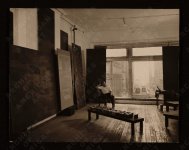
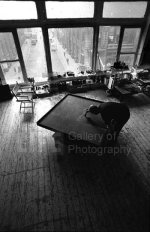
Back in my college days I put forward the argument at some length that Reinhardt was actually rendering the Manhattan traffic grid without realizing it in his late cruciform pieces. Please think about this possibility for a moment as you peruse these photographic shots of Ad Reinhardt in his studio. The first picture was taken in 1955. The last three shots were taken of Reinhardt working at the very end of his life, and he is in fact working on the "black paintings" in them:

Reinhardt_studio.jpg
Reinhardt_studio_2.jpg
Reinhardt_studio_3.jpg
see the above picture in larger format here

Reinhardt_studio_4.jpg
see the above picture in larger format here

Most art historians who write about Reinhardt get caught up in talking about the cruciform pattern as a Christian subtext. I said in my paper basically, no, this guy is looking out of his window all day while he paints, and then subliminating that into the paintings themselves. Not so different in a way from Monet painting in his garden, really. Except it maybe wasn't conscious for Reinhardt. He was basically extrapolating the grid system as the universal.

I would argue that Frank Cornelissen deeply loves Etna, he feels a deep connection with it was a entirely special place, and he is trying to put Etna in a bottle unspoiled and send it off to you. It is easy to get hung up about the details of what his technique imply, but I think that all of that discussion is basically secondary. Frank is basically looking out his window each day, and that view has become the sublimated drive for him. He loves Etna and he is extrapolating it as a universal.

With this in mind, keep in mind that Reinhardt was also working in a very rarefied way, with the purpose of eliminating the appearance of brushstrokes. Consider this quote from The New York Times: "The black paintings are delicate: the mere touch of a finger leaves a permanent imprint. Their fragility contributed to them being perceived, and valued, as pure things in a corrupted world." (to find where this is talked about in the NYT, go here)

Consider also Reinhardt's own summation of his "black painting": A free, unmanipulated, unmanipulatable, useless, unmarketable, irreducible, unphotographable, unreproducible, inexplicable icon.

I think the parallels are striking.
 

Attachments

  • Reinhardt_studio.jpg
    Reinhardt_studio.jpg
    163.3 KB · Views: 0
  • Reinhardt_studio_2.jpg
    Reinhardt_studio_2.jpg
    43.6 KB · Views: 0
Another awesome post, Levi, you are spoiling us rotten. I love Reinhardt's work and wrote about "death of painting" endgames like his, characteristic of modernism, in the first chapter of Dudi Maia Rosa and the Deaths of Painting (available in English as a pdf in oswaldocosta.com). The chapter starts with numerous quotes from artists who claimed to have "killed" painting. I also don't see the final crosses as religious. He had an additional intention, to make paintings that could not be reproduced, that had to be experienced in person. An intimate rejection of mechanical reproduction. He wanted art to be experienced the only way wine can be, in person.
 
That's cool you guys got to meet Frank. It doesn't appear he's coming to the west coast, so it's interesting to hear what's new and get additional insights from his visit there. It seems like he has continued to refine
how he goes about pursuing his vision and from my limited experience he's making progress.
 
Thanks very much, all of you, for the reportage and the insights.

He felt that his wines showed better in Japan than on Mt. Etna, which he ascribed in part to higher magnetic energy from the volcano.
Could you (or anyone) interpret this? How does he think magnetism interacts with his wine?
 
originally posted by Levi Dalton:


Frank specifically told me that the Magma 6va was all from 2007, and that that was part of his philosophy for the Magma bottling: 1 grape, 1 site, 1 year.

the munjebel rosso was the multivintage wine.
 
Levi,
Thanks for the interesting thoughts.

Being essentially a trivial guy, I'm trying to figure out where Reinhardt's window looks--is that the bottom of Crosby St.? Seems too busy. His studio building breaks the grid, and there aren't all that many places where that happens. Do you know?
 
As i look back now to my notes, yes, the Munjebel is the multi vintage wine not the Magma. Even as i was writing that last night i was second guessing myself; ill blame in on the mild fever i was running...

Thanks Levi for your additional notes, it seems we both had a great interaction with Frank.
 
originally posted by Thor:

He felt that his wines showed better in Japan than on Mt. Etna, which he ascribed in part to higher magnetic energy from the volcano.
Could you (or anyone) interpret this? How does he think magnetism interacts with his wine?

Probably it would be best to email Frank and have him answer this. I have found him responsive to email.
 
But then I'd feel bad about making fun of the notion later. Maybe I'll just send him a Wine Clip and have done with it.
 
The end of painting? Almost no brush strokes, almost no color, almost no contrast, almost no figure... it doesn't sound that dissimilar to a blank canvas, which would be the beginning of painting.
 
originally posted by Jeff Grossman:
The end of painting? Almost no brush strokes, almost no color, almost no contrast, almost no figure... it doesn't sound that dissimilar to a blank canvas, which would be the beginning of painting.

What it was was the beginning, with Frank Stella (and to some extent Jasper Johns) of Minimalism. Minimalism was a reaction to painterly, expressive abstraction. In the same way that you could say that what Cornelissen is doing is in reaction to interventionist winemaking.

"I had read an article on Ad Reinhardt in Art News in the early 1950s and knew he was an important member of the New York School. But I was not prepared for the first exhibition of his work I saw at Betty Parsons' New York gallery in November 1956. The show was Reinhardt's first to include only his black paintings. The opening was fascinating. The gallery was filled with young people-it seemed I was the only person over 30 in the crowd-and I could hear animated and approving comments all over the place. But I was baffled. I saw only black paintings. I could not figure out the enthusiasm. That worried me, because I knew that others were seeing something in those pictures that I did not. I am not being arch or naive when I make these statements. The fact that I learned later to appreciate Reinhardt's black paintings, to understand them and see the wonderful, subtle gradations of colors in their surfaces, does not change or mitigate my initial impression of the black paintings. The young artists caught on to what Reinhardt was up to much more quickly than I did." - art collector Charles H. Carpenter, Jr
 
originally posted by SFJoe:
Levi,
Thanks for the interesting thoughts.

Being essentially a trivial guy, I'm trying to figure out where Reinhardt's window looks--is that the bottom of Crosby St.? Seems too busy. His studio building breaks the grid, and there aren't all that many places where that happens. Do you know?

"From 1968 to 1977, I had been renting the ex-studio of Ad Reinhardt at 75th between 1st and York. It was like a SoHo loft only uptown. Lieberman, Frankenthaler, Castro Cid, Ferrorelli and Avedon had their studios there."

- Carla Lavatelli
 
originally posted by Levi Dalton:
originally posted by SFJoe:
Levi,
Thanks for the interesting thoughts.

Being essentially a trivial guy, I'm trying to figure out where Reinhardt's window looks--is that the bottom of Crosby St.? Seems too busy. His studio building breaks the grid, and there aren't all that many places where that happens. Do you know?

"From 1968 to 1977, I had been renting the ex-studio of Ad Reinhardt at 75th between 1st and York. It was like a SoHo loft only uptown. Lieberman, Frankenthaler, Castro Cid, Ferrorelli and Avedon had their studios there."

- Carla Lavatelli
Huh. but his building dead-ends the street. Doesn't seem to fit.
 
originally posted by SFJoe:
originally posted by Levi Dalton:
originally posted by SFJoe:
Levi,
Thanks for the interesting thoughts.

Being essentially a trivial guy, I'm trying to figure out where Reinhardt's window looks--is that the bottom of Crosby St.? Seems too busy. His studio building breaks the grid, and there aren't all that many places where that happens. Do you know?

"From 1968 to 1977, I had been renting the ex-studio of Ad Reinhardt at 75th between 1st and York. It was like a SoHo loft only uptown. Lieberman, Frankenthaler, Castro Cid, Ferrorelli and Avedon had their studios there."

- Carla Lavatelli
Huh. but his building dead-ends the street. Doesn't seem to fit.

That is pretty far east. Would it make sense that he is dead ending the street (and not the avenue), with the FDR behind him on the other side?

I'll take a look tonight. It is on my way home.
 
Back
Top