Matteo, I didn't actually say that about the ripeness, Scott R. did. I was in a picture in the same post, however.
Frank specifically told me that the Magma 6va was all from 2007, and that that was part of his philosophy for the Magma bottling: 1 grape, 1 site, 1 year.
Just to note a few other things Frank told me:
His anfora were sourced from Spain, and they have been layered inside with an enamel or epoxy. He specifically doesn't want an anfora taste note in the wines, which is something he would see as an interference. He also doesn't want to use sulphur to clean the inside of the anfora, and he feels he can avoid that by lining them. He said the lining process is quite costly, and that he had considered a beeswax lining as another option. He also said that he has experimented with fermenting in anfora, but no longer does it.
The winery will be moving shortly to a larger facility in Passopisciaro, the next town over. In case you were wondering, it takes 3-4 guys, as many shovels, and a van to dig up an anfora and move it to a new facility.
Frank said that he prefers to decant his Bianco wines off the sediment, but that he prefers to serve the Rosso without decanting. He also said that he is aiming to have less sediment in the bottle moving forward.
He felt that his wines showed better in Japan than on Mt. Etna, which he ascribed in part to higher magnetic energy from the volcano.
I asked him which other producers on Etna he admired, and he surprised me by answering that he had a great friendship with Franchetti, and was often at the Passopisciaro winery. He acknowledged that the winemaking was quite different than his own, but seemed drawn to Andrea Franchetti's personality/life force. He also mentioned Junko Arai as having an amazing energy/life force.
Frank said he was aiming for more forward fruit these days, a change from his earlier style, and when I remarked about his Susucaru 2 rosato in this context he agreed that it was a move in the direction he was talking about.
I asked him if he had accomplished what he had set out to do, and Frank replied that he intends to start back on the very vine material, a project that could take 40 years. He wants to grow pie franco vines from seed, and then propogate them. He said that it is a project that he will start, and that he expects his children to continue. Frank became a first time father 6 months ago with the birth of a baby boy.
Frank expounded at some length about how he felt Etna was a special place for doing what he does, and also for skiing, which is something he loves to do.
He said that he will not be at the winery this year during the big Etna growers show, because of a scheduling conflict. He hoped to be in attendance next year.
In the end, Frank and his stance in the wine world reminds me a great deal of the views of this man
Ad Reinhardt (1913-1967).
Mr. Reinhardt did a series of paintings that he described as the "ultimate" paintings, and referred to them as the logical end of painting. He wasn't saying that others couldn't or wouldn't paint after him, just that his paintings were the "end" of painting, the last possible amongst a field of possibilities. Reinhardt was supposing that he was taking painting as far as it could go formally.
Here is an example of one of those paintings:
What may not be clear upon first looking at the above is that there is a subtly submerged cruciform pattern in the painting. A greek cross, basically. This earlier painting from Reinhardt renders a more visible view of a similar pattern:
See that pattern?
Reinhardt was deeply concerned with that pattern towards the end of his career/life. It would become the basis for what he called the "ultimate" paintings, also known as the "black paintings".
Just as a point of reference, this sort of thing
is what Reinhardt had been up to prior to becoming wholely absorbed with the cruciform pattern. The "red" painting is from 1950, the "blue" from the mid-50's, and the "black" from the mid-60's. Reinhardt also did several comic type pieces that were satirical about the art world.
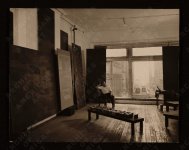
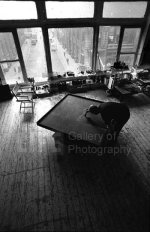
Back in my college days I put forward the argument at some length that Reinhardt was actually rendering the Manhattan traffic grid without realizing it in his late cruciform pieces. Please think about this possibility for a moment as you peruse these photographic shots of Ad Reinhardt in his studio. The first picture was taken in 1955. The last three shots were taken of Reinhardt working at the very end of his life, and he is in fact working on the "black paintings" in them:
see the above picture in larger format here
see the above picture in larger format here
Most art historians who write about Reinhardt get caught up in talking about the cruciform pattern as a Christian subtext. I said in my paper basically, no, this guy is looking out of his window all day while he paints, and then subliminating that into the paintings themselves. Not so different in a way from Monet painting in his garden, really. Except it maybe wasn't conscious for Reinhardt. He was basically extrapolating the grid system as the universal.
I would argue that Frank Cornelissen deeply loves Etna, he feels a deep connection with it was a entirely special place, and he is trying to put Etna in a bottle unspoiled and send it off to you. It is easy to get hung up about the details of what his technique imply, but I think that all of that discussion is basically secondary. Frank is basically looking out his window each day, and that view has become the sublimated drive for him. He loves Etna and he is extrapolating it as a universal.
With this in mind, keep in mind that Reinhardt was also working in a very rarefied way, with the purpose of eliminating the appearance of brushstrokes. Consider this quote from
The New York Times: "The black paintings are delicate: the mere touch of a finger leaves a permanent imprint. Their fragility contributed to them being perceived, and valued, as pure things in a corrupted world." (to find where this is talked about in the NYT, go here)
Consider also Reinhardt's own summation of his "black painting": A free, unmanipulated, unmanipulatable, useless, unmarketable, irreducible, unphotographable, unreproducible, inexplicable icon.
I think the parallels are striking.